
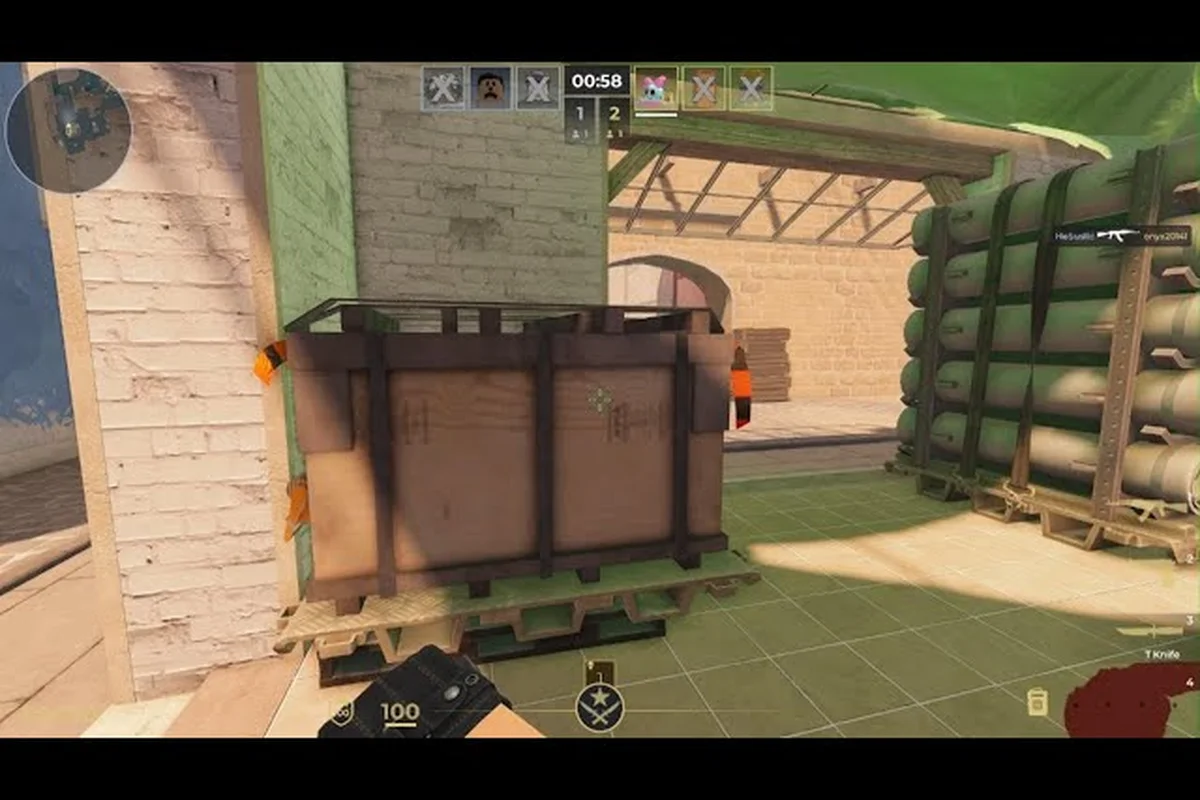
BloxStrike bomb site mode is the 5v5 plant-and-defuse experience that defines the game's competitive ladder, and mastering its rules is the single fastest way to climb Elo. Every round hinges on a planted explosive at one of two bomb sites, a ticking clock, and the micro-decisions your team makes between buying utility and trading kills. Whether you queue unranked to warm up or hop straight into ranked, understanding the core loop separates the players who plateau from the ones who steadily push into higher tiers.
How BloxStrike Bomb Site Mode Works
BloxStrike bomb site mode runs as a 5-versus-5 tactical shooter where attackers must carry an explosive to a designated site and plant it, while defenders try to hold angles, delay the plant, and ultimately defuse. According to the official BloxStrike Roblox game page, matches play out across the two main bomb sites available on every map, and rounds end in one of three ways: bomb detonation, successful defuse, or total elimination of one side. The developer created the experience on May 2, 2025, and by October 2026 the title had passed 293 million visits with a 94.6 percent positive rating from more than 623 thousand upvotes.
Core Round Structure
Each bomb site mode match in BloxStrike competitive is split into two halves of six rounds apiece for a standard twelve-round format, with a halftime swap that moves the attacking side to defense and vice versa. Players who queue unranked follow the same round logic but without Elo consequences, which makes unranked a low-pressure environment to rehearse plant positions and post-plant retakes. Rounds last up to a fixed time limit before the bomb auto-detonates if planted, and defenders win by defusing before the timer runs out.
| Phase | Duration | Attacker Objective | Defender Objective |
|---|---|---|---|
| Buy phase | ~15 seconds | Purchase weapons, armor, utility | Match opponent's spend, save if needed |
| Execute | ~40 seconds | Reach site, trade utility, plant the bomb | Hold angles, delay the push, bait utility |
| Post-plant | ~35 seconds | Play off the bomb timer, deny defuse | Stack the site, line up crossfire on the defuser |
| Resolution | Instant | Survive and let the bomb explode | Kill the planter or finish the defuse |
The bomb site mode favors teams who treat each phase as a distinct micro-game. Buy phase decisions dictate whether you can full-buy rifles plus utility next round or are forced into a partial save, and post-plant positioning is often more important than the plant itself because a poorly anchored plant gives defenders free defuse angles.
Roles Within a Team
Although players are not locked to a rigid role system in competitive, bomb site mode rewards a fluid five-person composition that typically includes two entry fraggers, one in-game leader, one support player buying utility for the team, and one AWPer or designated sniper. On defense, the structure shifts to two site anchors, one rotator, one lurker watching mid, and one flex player who calls the early information. The exact composition varies by map, but the principles of overlapping crossfires and trade-friendly positioning never change.
BloxStrike Modes, Unranked, and Ranked Differences
BloxStrike currently ships with two primary competitive queues, and players regularly ask how the bomb site mode differs between them. The table below summarizes the core differences reported by the community and reflected in the official matchmaking flow.
| Queue | Elo Impact | Matchmaking Strictness | Best For |
|---|---|---|---|
| BloxStrike unranked | None | Lenient, allows wider skill variance | Warming up, learning callouts, testing loadouts |
| BloxStrike ranked | Gains and losses per match | Tight, tries to keep you near your Elo | Climbing the ladder, proving progression |
| BloxStrike competitive (premade) | Gains and losses per match | Tight plus party balancing | Coordinated 3-stacks and full 5-stacks |
Unranked bomb site mode is the training ground. You can experiment with off-meta weapons, learn plant spots for a new map, and rehearse retake lineups without your Elo suffering if a round goes sideways. Ranked, on the other hand, applies the full Elo formula and demands a tighter approach because every loss chips away at the rating you have spent dozens of matches building.
Grinding Unranked Before the Ranked Queue
New players should grind at least twenty unranked bomb site mode rounds before dipping into ranked so the callouts, bomb timer behavior, and buy phase rhythm feel second nature. Returning players who have not touched the mode in a while benefit from a five-to-ten-round unranked warm-up to recalibrate crosshair placement. Veterans, by contrast, often use unranked only to test specific scenarios such as a new post-plant smoke lineup or an off-angle plant on the B site.
Bomb Timer, Plant Mechanics, and Defuse Windows
The defining mechanic of bomb site mode is the bomb timer itself, because it converts every round into a race against the clock. Once the explosive is planted, a roughly thirty-five-second fuse begins, and the defending team has only a small portion of that window to defuse. Defusing takes a set number of seconds and can be completed only by the player who has line-of-sight to the bomb and no active threat; any incoming damage interrupts the defuse, which is why post-plant anchor positions are so decisive.
Plant Spots and Defuse Angles
Not every plant is created equal. A default plant in the open gives defenders an easy defuse, while a safe plant tucked behind cover forces them into an off-angle retake. The BloxStrike map callout guide breaks down the named plant positions per map, but the universal rule is that the further the bomb is from the site's main entrance, the longer defenders must expose themselves to retrieve it.
| Plant Style | Defuser Difficulty | Attacker Trade Potential | Risk Level |
|---|---|---|---|
| Default open plant | Easy, short defuse path | High, defenders peek with info | Low |
| Safe corner plant | Medium, defender must commit | Medium, attackers retake from cover | Medium |
| Deep back-site plant | Hard, long defuse path | Low, attackers play time | High |
Defending teams who want to counter a deep plant must either pre-rotate a player to lurk for the planter, or smoke and molotov the site before committing to the retake, which is exactly the kind of utility usage the buy phase economy rewards.
Round Timer vs. Bomb Timer
A common mistake among newer players is confusing the round timer with the bomb timer. The round timer in bomb site mode governs the entire pre-plant phase; if attackers have not planted by the time it expires, the defenders automatically win the round. Once the bomb is planted, however, the round clock is replaced by the bomb fuse, which means defenders no longer have to chase kills across the map and can instead collapse onto the site for a coordinated retake. Understanding the handoff between these two timers is the single biggest difference between rounds where you find yourself stranded mid-map and rounds where you hold the defuse cleanly.
Climbing Elo in BloxStrike Ranked
Climbing Elo in BloxStrike competitive is not just about aim; the ladder rewards consistency, communication, and macro-decision making more than raw mechanical skill. The Elo formula is hidden from public view, but community testing on r/bloxstrike suggests that winning against a higher-rated team yields a bigger gain than winning against a comparable opponent, while losing to a much weaker team costs a disproportionately large chunk of rating. This means that grinding an easy rank bracket is one of the worst ways to climb; instead, you want to push into matches where you are the underdog and convert as many of those as possible.
What Elo Gains Look Like in Practice
The following table illustrates the rough Elo deltas that community trackers have reported over a five-match block for a mid-tier player. Exact numbers vary by patch, but the relative shape of the curve is consistent.
| Match Result | Opponent Tier | Approx. Elo Change | Streak Note |
|---|---|---|---|
| Win vs. equal rank | Same Elo bracket | +18 to +22 | Neutral |
| Win vs. higher rank | +50 Elo above | +28 to +35 | Strong gain |
| Loss vs. equal rank | Same Elo bracket | -16 to -20 | Neutral |
| Loss vs. lower rank | -50 Elo below | -25 to -32 | Painful drop |
| Win after 3-loss streak | Mixed | +30 with streak bonus | Rebound gain |
If you are stuck in a hard Elo plateau, the fix is almost always one of three things: better utility usage in the buy phase, sharper post-plant positioning, or a tighter lurk setup that splits defender attention. Aim training helps, but only at the margins once you reach the mid ranks.
Ranked Pacing and Mental Game
Tilt is the silent Elo killer in bomb site mode. Players who queue three ranked matches in a row after a brutal loss usually bleed rating because their decision-making collapses into autopiloted duels. A better rhythm is two ranked matches followed by one unranked warm-up, which lets you reset between competitive sessions and keeps the Elo swing from snowballing the wrong way. For a deeper look at how the ladder curves and what each tier expects from your playstyle, the broader BloxStrike game modes overview pairs nicely with this guide.
Strategy, Callouts, and Utility Usage
Utility is the great equalizer in bomb site mode because a well-timed smoke or molotov can shut down a defender's crossfire even if the opponents have the better aim. Attackers should spend at least one round learning the map's standard execute smokes, and defenders should invest in a flashbang for the retake so they can pop it over the site and force the attackers off the bomb. The most common mistake is hoarding utility for the entire half and then dying with two unused flashes in your pocket; the buy phase economy is forgiving enough that you can re-buy next round if you use everything to win this one.
Standard Execute Setup
A clean B-site execute from the bombsite mode meta usually follows a three-step pattern: a smoke to block the AWPer's sightline, a molotov to deny the off-angle, then a coordinated entry trade onto the plant. The exact lineup varies by map, but the structure never does. Defenders who recognize the setup can counter-flash the entry and rotate a third player from mid to swing the numbers before the plant even goes down, which is why good teams always call out how many utility pieces they have used on the execute so the next round's buy can be planned around the cooldown.
| Execute Step | Attacker Action | Defender Counter |
|---|---|---|
| 1. Smoke line | Block cross-site angles with two smokes | Reposition to off-angle, ready to retake |
| 2. Mollie box | Force defenders off default positions | Back off, save HP for retake |
| 3. Entry trade | Two players push the bomb site together | Pop flash, swing for the trade kill |
Mid-Round Adapting and Calling
Mid-round adapting is where ranked games are actually won. If the first twenty seconds reveal that the defenders are stacking one site, the in-game leader should call a fast rotate to the opposite site, which both wastes the defenders' stack and opens the round for a free plant. On the defensive side, calling a fake rotate is just as effective: one player makes noise at the bombsite B door while the rest of the team hides on A, and the attackers walk straight into a five-man stack with crossfires pre-set up.
Frequently Asked Questions
What is the BloxStrike bomb site mode and how does it differ from other modes?
The BloxStrike bomb site mode is the 5v5 plant-and-defuse competitive mode where attackers carry an explosive to one of two sites while defenders try to hold and defuse it. It is distinct from deathmatch-style modes because the round ends on bomb detonation, defuse, or elimination, and every round grants cash for the next buy phase, which is the core loop that defines the ranked experience.
How much Elo do you gain per win in BloxStrike ranked?
Community trackers report roughly 18 to 22 Elo per win against an equal-ranked opponent, with bigger gains of 28 to 35 Elo when you beat a higher-rated team. Losses against weaker opponents hurt more than losses against equal ranks, which is why grinding an easy bracket is one of the least efficient ways to climb.
Should new players start in unranked or jump straight into ranked?
New players should play at least twenty unranked rounds first to learn callouts, plant spots, and the bomb timer behavior. The unranked queue uses the same bomb site rules as ranked but with no Elo impact, so it is the lowest-risk place to fail and learn before the Elo stakes kick in.
How long is the bomb timer in BloxStrike bomb site mode?
The planted bomb runs a roughly thirty-five-second fuse, and defusing takes only a few seconds if the defender can hold the bomb without being interrupted. Attackers win by planting in a position that delays the defuse long enough for the fuse to expire, while defenders win by interrupting the defuse or by eliminating all five attackers before the plant.
Can you queue ranked in a full five-stack on BloxStrike?
Yes, BloxStrike ranked supports full five-player parties and the matchmaking system tries to balance the opposing team's average Elo against your squad. Five-stacks usually climb faster because communication and utility coordination are tighter, but a poorly coordinated stack can drag everyone's Elo down faster than solo queue.