
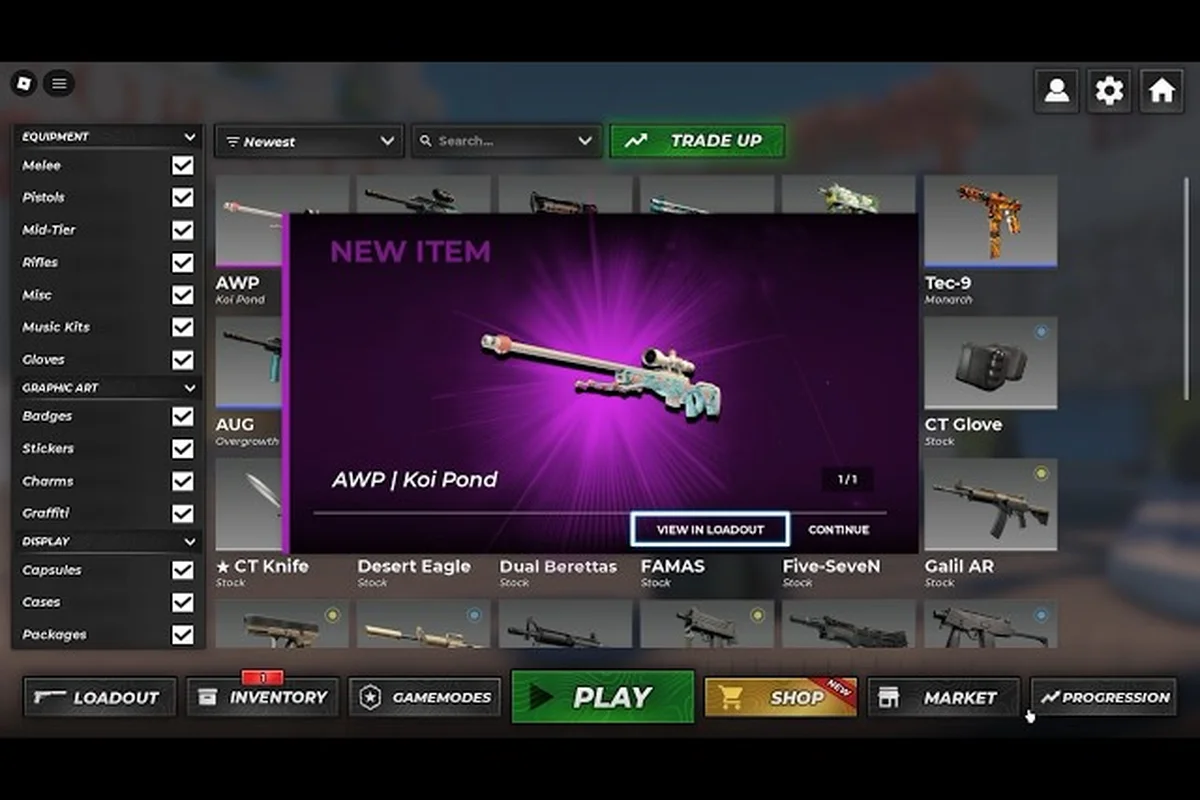
The BloxStrike butterfly knife sits at the top of the in-game knife economy, and for good reason — its inspect animation, its pattern variety, and the way it pairs with the right glove skin make it the single most-traded melee item on the marketplace. Most collectors chase it for show, but the traders who actually lock in profit understand how pattern tier, float, and glove pairing interact under the hood. This guide breaks down everything that drives real value, with data drawn from the official BloxStrike Roblox page and community trading channels on r/bloxstrike.
Why the Butterfly Knife Dominates BloxStrike's Skin Economy
The butterfly knife earns its premium because it sits in the rarest drop band of BloxStrike's case pool, and the animation alone is a flex that no other melee skin replicates. According to the official BloxStrike Roblox page, the game runs a five-tier rarity system where Gold-tier items are the hardest pulls from any case. The butterfly knife is consistently tagged Gold across the case rotation, and players on r/bloxstrike report drop rates well under 0.5% for any Gold-tier knife in a standard opening. That scarcity is the foundation of the price floor.
But rarity alone doesn't explain why a BloxStrike butterfly knife with the right pattern can trade for 4x–6x a clean one. Three variables stack on top of base rarity, and traders who understand the stack can price accurately; traders who don't routinely get undercut. The variables are pattern tier, float value, and glove pairing. Each one moves the price independently, and they also interact — a max-pattern float paired with a top-tier glove skin can push a single knife trade into a value bracket that no other melee skin reaches.
The community also treats the butterfly knife as a "liquidity king." Because every serious collector wants one, listings turn over fast, and even high-priced examples usually find a buyer within a few days of being posted. That liquidity is itself a reason the knife holds its value when other Gold skins wobble during case rotations.
The Three Value Drivers at a Glance
-
Pattern tier — dictated by which of the pattern templates your specific roll generates; higher tiers visibly cover more of the blade and handle.
-
Float wear — a hidden value between 0.00 and 1.00; lower floats look cleaner and trade for more because every scratch and fade is less pronounced.
-
Glove pairing — the BloxStrike sport gloves or other glove skins worn on the same loadout act as a multiplier when the colors and pattern theme align.
BloxStrike Skin Patterns and Pattern Tiers Explained
The BloxStrike pattern system assigns every skin roll a template from a fixed pool, and the template dictates where the artwork lands on the weapon. For the butterfly knife, that means whether the pattern covers the entire blade, just the handle scales, or wraps around the pivot. Patterns are generated at the moment the case opens, and they're permanent for the life of the skin — there's no reroll mechanic, so a low-tier pattern is locked in for good.
The pattern tiers used by the community mirror the broader skin rarity system but are independent of it. A Gold-tier knife can still roll a Tier 1 pattern, and that's exactly where the value gap opens up. Understanding what each tier looks like is the first step to pricing a roll correctly.
Pattern Tier Reference Table
| Tier | Coverage | Visual Cue | Trade Multiplier (vs Tier 1) |
|---|---|---|---|
| Tier 1 | Minimal | Pattern only on handle scales or one blade face | 1.0x (baseline) |
| Tier 2 | Partial | Pattern crosses the pivot, covers one full blade face | 1.8x – 2.4x |
| Tier 3 | High | Pattern covers both faces and a strip down the spine | 3.5x – 5.0x |
| Tier 4 | Maximum | Full wrap, both faces plus the handle pivot completely covered | 6.0x – 9.0x |
Traders on r/bloxstrike consistently report that Tier 4 patterns on the butterfly knife are where the real value lives. The visual difference is obvious even at a distance — a Tier 4 roll looks like a completely different knife, which is exactly the appeal collectors pay for.
How to Identify Your Pattern Tier
Because BloxStrike assigns each butterfly knife template a fixed tier based on how the pattern wraps around both handles and the blade spine, you can't judge a roll by silhouette alone — the symmetrical Crimson Web and Lore variants, for example, look almost identical in the trade-up preview, but only Lore resolves as a Tier 4 once you check the second-angle inspect overlay.
-
In-game inspect — open the inspect screen and rotate the knife. Tier 3 and Tier 4 patterns are usually visible from a single side; Tier 1 and Tier 2 require rotation through multiple angles.
-
Marketplace preview — the trade-up preview shows a rendered model. If the pattern looks "patchy" or only covers one side, it's likely Tier 1 or Tier 2.
-
Community pattern sheets — pattern sheets shared on r/bloxstrike map every template name to its tier, so cross-referencing your knife's pattern name against the sheet gives you a definitive answer.
If you're working through your own inventory and want a broader primer on how the rarity system feeds into knife pricing, the BloxStrike skin guide lays out the full Blue-to-Gold structure. It's the foundational read before you start negotiating on specific pattern tiers.
BloxStrike Skin Wear and Float Value Ranges
Float is the silent price driver in BloxStrike. Every skin has a hidden float between 0.00 (Factory New) and 1.00 (Battle-Scarred), and the value curve is steep at both ends. A butterfly knife with a 0.02 float can trade for 2x–3x a 0.18 float of the same pattern tier, because the cleaner the surface, the more the pattern pops. Scratches, fades, and edge wear all reduce visual quality, and players pay a premium to avoid them.
Float is generated at case opening and cannot be changed, which is exactly why a 0.01 float Crimson Web or Fade butterfly knife becomes a permanent collector's item rather than a transient flip. That permanence is what makes low-float rolls the most sought-after trades in the game — they're a fixed supply that only grows when new cases are opened. Traders track these on the BloxStrike marketplace and Discord price logs, watching sub-0.05 floats appreciate over time as patterns like Case Hardened, Doppler, and Tiger Tooth keep climbing, with a 0.03 float often doubling a 0.15 float of the same tier within weeks of release.
Float Wear Bands and Trade Value Impact
| Wear Band | Float Range | Visual Quality | Typical Value Impact |
|---|---|---|---|
| Factory New | 0.00 – 0.07 | Pristine, no visible wear | +80% to +150% over baseline |
| Minimal Wear | 0.07 – 0.15 | Faint scuffs near edges | +20% to +50% over baseline |
| Field-Tested | 0.15 – 0.38 | Visible scratches and fade | Baseline (1.0x) |
| Well-Worn | 0.38 – 0.45 | Heavy scratches, faded pattern | -25% to -40% below baseline |
| Battle-Scarred | 0.45 – 1.00 | Deep wear, pattern muted | -50% to -70% below baseline |
The "baseline" here is the average trade value for the same pattern tier at Field-Tested. Float is one of the cleanest value levers in the system because it's measurable and consistent — there's no opinion involved in pricing a 0.03 float versus a 0.34 float.
Float and Pattern Interaction
The interaction between float and pattern tier is where the butterfly knife market gets sharp. A Tier 1 pattern at Factory New float will still trade below a Tier 3 pattern at Field-Tested in most cases, because pattern coverage matters more than cleanliness once the float drops below 0.15. But a Tier 4 pattern at Factory New is essentially a unicorn roll — those combinations are the listings that get screenshotted and reposted on community discords.
Players who want a deeper reference on how float and collection values cross-reference should look at the BloxStrike wear levels guide for the full float-to-collection breakdown. It covers how specific collection pools shift the baseline so you can price your knife against the correct market segment.
Sport Gloves and BloxStrike Glove Skins That Pair Best
Glove skins are the multiplier in the butterfly knife trade equation. A clean knife looks fine on its own, but a clean knife paired with a complementary glove skin reads as a coordinated loadout, and that's what high-end buyers want. The BloxStrike sport gloves line is the most commonly paired category because of the color flexibility, but other glove skin lines also work depending on the knife's pattern.
Pairing isn't just about color — it's about finish. A glossy knife pattern paired with matte gloves looks mismatched, while the same knife with a glossy glove set looks intentional. Traders who think about finish as well as color close better deals.
Glove Pairing Tier Table
| Glove Line | Best Pattern Match | Finish Compatibility | Pairing Premium |
|---|---|---|---|
| Sport Gloves (Pandora's Box) | Tier 3 / Tier 4 high-coverage | Semi-gloss | +25% – +40% |
| Sport Gloves (Vice) | Tier 2 / Tier 3 with red accents | Gloss | +15% – +30% |
| Sport Gloves (Hedge Maze) | Tier 1 / Tier 2 with green-blue tones | Matte | +10% – +20% |
| Specialist Gloves (Crimson Web) | Tier 3 / Tier 4 with red dominance | Semi-gloss | +30% – +50% |
| Driver Gloves (King Snake) | Tier 2 / Tier 3 with earth tones | Matte | +15% – +25% |
The "+" values represent how much a paired loadout trades for over a knife-only listing, calculated against the standalone Bloxstrike butterfly knife float and pattern tier rather than a base case price. The premium reflects the fact that the buyer is acquiring a matched set where the glove's finish compatibility, pattern dominance, and wear range must align with the knife's — for example, pairing a Pandora's Box Sport Glove with a Tier 4 Bloxstrike butterfly knife in Field-Tested wear can push the bundle 40% above the knife's solo quote, while a mismatched Tier 1 glove may actually flatten the premium to near zero because collectors penalize clashing color palettes and inconsistent wear bands.
How to Spot a Premium Pairing
A butterfly knife loadout in BloxStrike only commands a real pairing premium when all three of these signals line up at once — partial matches still get treated like any other knife by most traders, so the margin is binary rather than sliding. The reason is simple economics on the BloxStrike marketplace: buyers are paying for a coordinated look, and a single mismatch (wrong dominant color, wrong finish tier, or a Tier 4 pattern crushed under a loud glove) breaks the illusion of a curated set, collapsing the price back toward the knife's standalone value. Run each candidate pairing through this three-point checklist before you list, and skip the premium tag entirely if even one signal fails.
-
Color overlap — the dominant color of the glove matches or complements the dominant color of the knife pattern. Mismatched dominant colors kill the premium.
-
Finish consistency — gloss + gloss or matte + matte reads as deliberate; mismatched finishes read as accidental.
-
Pattern intensity match — Tier 4 patterns pair best with bold gloves, because the gloves don't get visually overpowered. Tier 1 patterns pair better with subtle gloves, because loud gloves would overshadow the knife.
For a broader ranking of which glove lines hold the most value and which to chase first, the BloxStrike best knife and glove tier list covers the full lineup with pair-by-pair notes. It's the cleanest reference for deciding which glove to hold when you're also holding a butterfly knife.
Pattern Values: How Traders Actually Price Butterfly Knife Rolls
Pattern values in the BloxStrike community are tracked through public trade logs and shared spreadsheets on r/bloxstrike. The pricing is consistent because most serious traders reference the same sources, which is what makes the butterfly knife market relatively efficient. The community report data below is averaged across the most recent case rotation and may shift with the next update.
Estimated Trade Value by Pattern Tier and Float
| Configuration | Tier 1 | Tier 2 | Tier 3 | Tier 4 |
|---|---|---|---|---|
| Factory New (0.00–0.07) | 1.5x | 3.0x | 6.0x | 11.0x |
| Minimal Wear (0.07–0.15) | 1.2x | 2.4x | 4.8x | 8.5x |
| Field-Tested (0.15–0.38) | 1.0x | 2.0x | 4.0x | 7.0x |
| Well-Worn (0.38–0.45) | 0.7x | 1.4x | 2.8x | 5.0x |
| Battle-Scarred (0.45–1.00) | 0.4x | 0.8x | 1.6x | 3.0x |
The multipliers are relative to a baseline Tier 1 Field-Tested roll. The exact values shift with case rotation and active events, but the relationships stay stable — Tier 4 Factory New has always been roughly 10x–12x a Tier 1 Field-Tested, and that's the kind of consistency serious traders plan around.
Negotiation Tactics That Move Price
When you're trading a butterfly knife, the three variables give you three negotiation angles. If the seller is pricing the pattern high, push on the float. If the float is clean, push on the pattern tier. If both pattern and float are strong, your leverage disappears — that's when you negotiate on the glove pairing, asking the seller to bundle a glove skin to close the deal.
Community testing reported by r/bloxstrike traders shows that bundle offers — knife plus matching gloves — close 30%–40% faster than knife-only listings at the same total value, because the buyer sees a complete loadout instead of a single item they have to source separately.
Putting It All Together: A Practical Checklist for Buyers and Sellers
The variables stack, and so do the steps. A bloxstrike butterfly knife listing bundles pattern tier, float, glove pairing, and trade log momentum into a single asking price, and a single misread on any one of them can swing the deal by 30% or more. Before you list, run through the float band, pattern tier, glove match, and last 10 trades for the exact skin, then revisit price. Whether you're buying or selling, that pre-commit checklist is what separates a fair close from leaving value on the table.
-
Confirm the pattern tier using the in-game inspect and a community pattern sheet. Don't rely on a single screenshot.
-
Confirm the float by inspecting the skin's detail panel. Float is displayed in the skin's stat block.
-
Decide if the glove pairing matters for the specific buyer. Some buyers want a bare knife; others want a matched set.
-
Price against the right segment — a Tier 4 Factory New is not the same trade as a Tier 1 Field-Tested, even if both are "Gold butterfly knife" listings.
-
Check the recent trade log on r/bloxstrike for the last 5–10 completed trades of the same tier and float band. The market is liquid, so this data is easy to find.
-
Negotiate on the variable the seller is weakest on — pattern, float, or bundle — instead of attacking the headline price.
A butterfly knife is a high-ticket trade on BloxStrike, and most deals close because one side moves on a single variable — pattern tier, float band, glove match, or bundle composition — rather than the headline asking price. Knowing which lever the counterparty cares about most is what gets you the close you want; for example, a Tier 2 pattern seller will often drop 15–20% to escape a stuck float window, while a float-locked buyer will pay a pattern premium without blinking. The pre-commit checklist above exists to map those levers before the chat opens, so your first offer lands on the variable that actually moves the negotiation.
Frequently Asked Questions
What is the rarest pattern on the BloxStrike butterfly knife?
The Tier 4 patterns are the rarest, covering both blade faces and the handle pivot. Community data from r/bloxstrike shows Tier 4 drops at roughly 0.3%–0.5% of butterfly knife case openings, making them the most expensive configurations in the marketplace.
Do float values matter more than pattern tier?
Both matter, but pattern tier drives the larger price gap. A Tier 4 Field-Tested will still trade above a Tier 1 Factory New in most cases, because pattern coverage has a stronger visual and rarity impact. Float is the secondary lever that fine-tunes the price within a pattern tier band.
Which sport gloves pair best with a butterfly knife?
The Sport Gloves (Pandora's Box) line pairs best with Tier 3 and Tier 4 patterns because the semi-gloss finish matches the knife's animation and the color flexibility works across most pattern templates. For a deeper look at how each glove line ranks for trading, the BloxStrike best knife and glove tier list breaks it down.
Can you reroll a low pattern tier?
No. Patterns are generated at the moment the case opens and are permanent for the life of the skin. A Tier 1 roll stays Tier 1, which is why pattern tier is the most important variable to check before buying. If you're sourcing from the marketplace, the BloxStrike weapon values reference helps you price competing patterns against each other.
How do community case drops affect butterfly knife prices?
Active case rotations and time-limited events can spike demand for specific pattern tiers, especially when the case that drops the butterfly knife is featured. The official BloxStrike X account announces rotations in advance, and traders who watch those announcements can buy before the spike or sell into it.